

You obsess over thumbnails, watch times, and subscriber counts, optimizing every second of your videos for your human audience.
But what if your most important viewer isn't a person at all? What if it's the AI that’s quietly building the future of search, commerce, and knowledge itself?
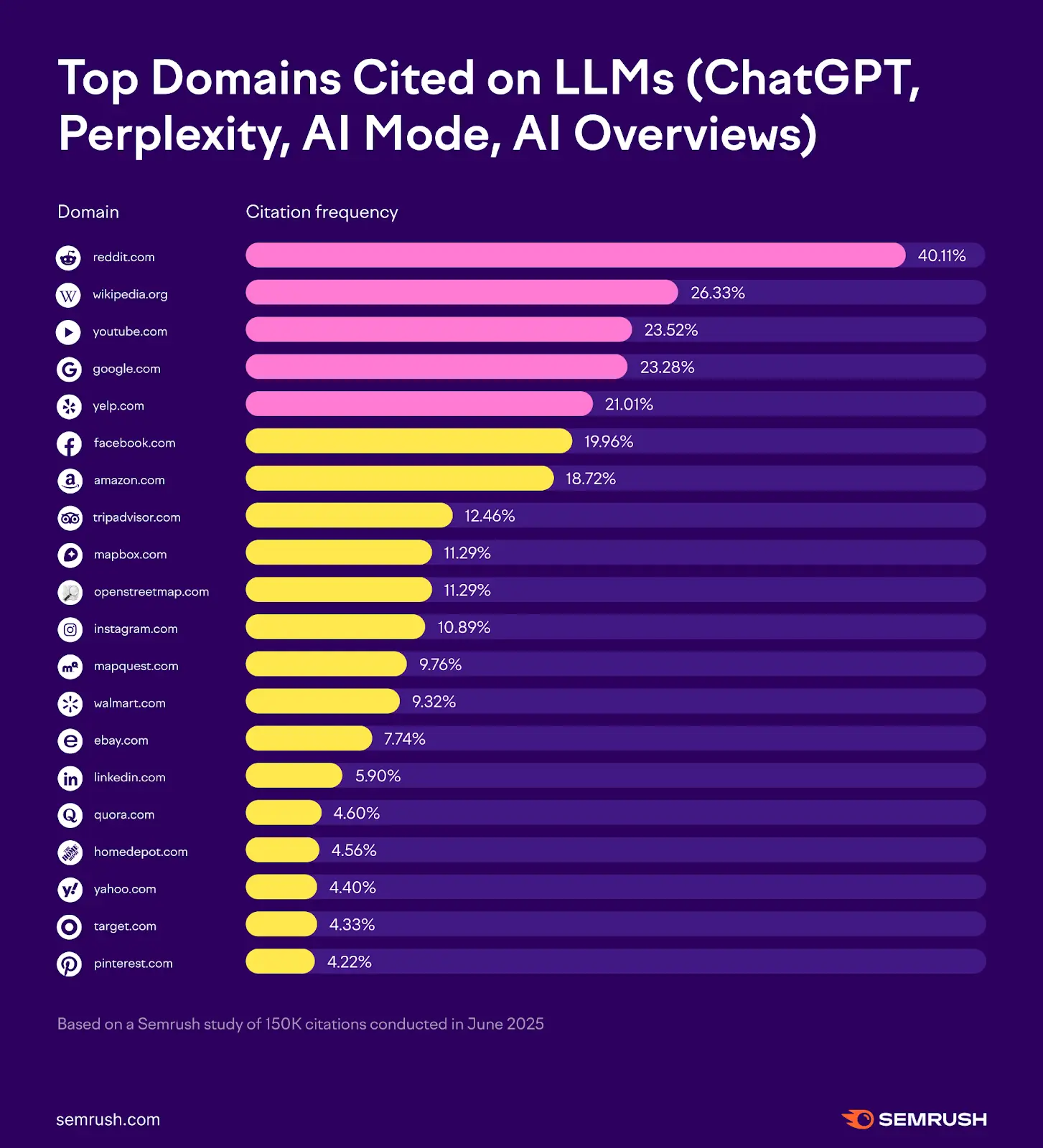
This isn't speculation. A groundbreaking June 2025 SEMrush study analyzing 150,000 AI citations just handed us the new rulebook. It revealed that when Large Language Models (LLMs) need to learn, they turn to a surprisingly familiar source: YouTube is the third most-cited domain in the entire digital world.
While Reddit offers the chaos of real-world conversation and Wikipedia provides structured facts, YouTube is where AI goes to see how things are done.- Data-Backed Importance: The SEMrush study confirms YouTube's critical role as a primary source for LLMs, ranking third globally.
- The Rise of GEO: This shift necessitates a new strategy beyond SEO—Generative Engine Optimization (GEO). The goal is to become the primary, citable source for AI-generated answers.
- YouTube’s Unique Role: YouTube delivers demonstrable, visual knowledge, a highly valuable and unique format for training AI.
- Actionable Industry Playbooks: Any business can leverage AI tools to create GEO-friendly video content that establishes authority with both human and AI audiences.
The Data: Why AI Trusts YouTube
To grasp the magnitude of this shift, consider the top domains AI models are learning from. The data shows a clear hierarchy of knowledge sources.
Top-Cited Domains Across LLMs (SEMrush, June 2025):
- reddit.com: The source for real-life experience and community conversation.
- wikipedia.org: The source for structured, factual, encyclopedic knowledge.
- youtube.com: The source for visual demonstration and process-oriented tutorials.
- google.com: The gateway to the wider web.
This data tells a powerful story. AI looks to YouTube to learn how things are done. Every "how-to" video, product demo, or explainer you publish is a potential textbook for the world's AI.
From SEO to GEO: Optimizing for Your New AI Audience
For years, the standard has been Search Engine Optimization (SEO). The new imperative is Generative Engine Optimization (GEO), the practice of structuring your content to be the definitive source chosen by an AI to construct an answer.
SEO gets you on the list. GEO makes you the answer.
Here’s how to apply GEO principles to your YouTube strategy:
- Answer-Oriented Titling: Frame titles as direct answers to questions. Instead of "Dhaka Real Estate Trends," use "What are the Key Property Investment Trends in Dhaka for 2025?"
- Structured for Clarity: Use YouTube’s chapter and timestamp features meticulously. Breaking a video into logical, labeled segments makes your content easily parsable for an AI.
- Demonstrate, Don't Just Describe: Show the process. A SaaS company should screen-record the exact clicks. An e-commerce brand should show the product being used in a real-world setting.
The Playbook: Industry-Specific GEO Strategies in Action
Creating citable, authoritative content is achievable for any business.
- E-commerce: Turn your product FAQs into a video series. Use an AI scriptwriter to craft short videos titled "How to Clean Your [Product Name]" or "[Product Name] vs. [Competitor]: A Visual Comparison."
- SaaS (Software as a Service): Your knowledge base is a GEO goldmine. Use AI tools to transform dense help articles into concise video tutorials. Animate complex workflows to provide a clear demonstration that an LLM can easily reference.
- Fintech: Build trust through clarity. Use AI topic analysis tools to find the most common financial questions in Bangladesh. Create a series on "Understanding Mobile Financial Services (MFS)" to become the authoritative source for financial literacy.
- B2B: Your expertise is your product. Record in-depth webinars and use an AI video editor to pull out the most salient points into a library of 3-minute clips, each answering a specific industry challenge.
- Real Estate: Sell with demonstrable clarity. Use AI-enhanced video tours that use on-screen text and voiceover to label features ("North-facing balcony for morning sun"). This structured data is perfect for AI to pull from.
Conclusion: Future-Proofing Your Brand's Authority
The SEMrush study is a clear signal: the line between content for people and data for machines is disappearing. The videos we produce today are actively defining the knowledge base of tomorrow's artificial intelligence.
By embracing a GEO mindset and using AI tools to create clear, authoritative, and demonstrative content on YouTube, you are not just marketing your business. You are securing its place as a trusted authority in the AI-driven world.
The question is no longer whether your audience is on YouTube; it's whether you are prepared to be the teacher for humans and machines alike.
Share your thoughts in the comments below!